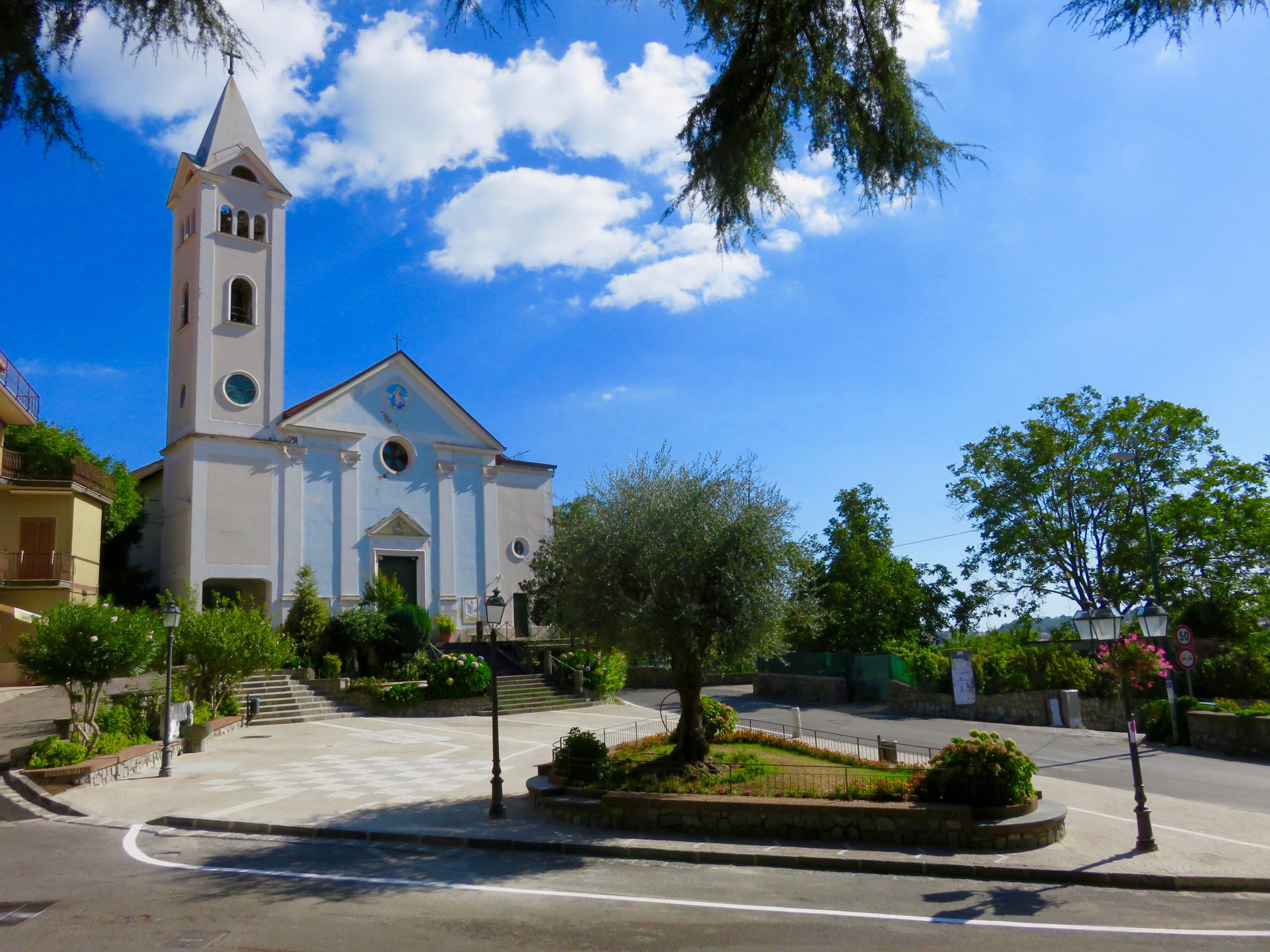
CHIESA MADONNA DELLE GRAZIE
CHURCH OF OUR LADY OF GRACES
The church is the scenic backdrop of Campora’s main square, on which it is located, for those coming from the lower part of the hamlet and heading toward San Lazzaro.
The church dedicated to Our Lady of Grace, S. Martino Bishop parish seat, it was built, by Governor Gian Battista Eboli, on an ancient chapel that still existed in 1698, as can be assumed from the plaque preserved in the same church. In 1867, work was carried out to consolidate the perimeter walls. At the end of the 19th century, the church was equipped with the bell and belfry from the small church of Saint Barbara. The church, formerly owned by the Monte Dei Morti Congregation of Campora, became the parish seat in 1942 and underwent numerous interventions over the years. In 1955 the new bell tower was inaugurated, and in the following years, between 1972 and 1977, Mons. Andrea Gallo repaired the whole interior of the building.
Description and artwork
Period: 19th century
The church has a single-nave floor plan punctuated by pilasters, with set round arches, from which is access to modest barrel-vaulted chapels intercommunicating with narrow passages that open behind the masonry pilasters that are surmounted by a high entablature that serves as a base for large windows with stained glass. The decoration of the church is quite rich and encompasses cornices and moldings with golden tones. Above the entrance is a modest choir with a linear tripartite balustrade, where an ancient pipe organ is placed. From the chapel adjacent to the apse is the access to the confession hall, a small room with a coffered ceiling and a side wall partly covered with a valuable mosaic depicting sacred scenes from the life of St. Martin; the room has a colored marble altar with a shrine where the statue of deposed Christ is located.
The sober front, preceded by a wide stone staircase, is outlined by pilasters that set a wrecked triangular gable, and is marked in the middle by the portal topped by a tondo with stained glass. The church façade becomes one with the adjoining bell tower, which rises with three orders of different holes and culminates by recapturing the architectural lines of the front fastigial with a broken tympanum supported by pilasters.
The roof of the flat nave holds a large canvas completed by Father Macario in 1973 that depicts Our Lady of Grace with St. Andrew and St. Martin in the act of giving a cloak to a poor man. The spherical dome, elegantly decorated, is set by frescoed pendentives depicting the four cardinal virtues: Justice, Prudence, Fortitude and Temperance, and in the apse, we can admire a fine marble altar from the old Teresian Monastery.
- Wooden statue Our Lady of Graces, unknown author (18th).
- Wooden bust of Saint Martin the Bishop by Picano (18th century).
- Statue of the Immaculate Conception from the old monastery of St. Theresa of Citarelli (early 1800s).
- Wooden crucifix, unknown author (18th);
- Crucified Jesus Processional banner (17th);
- Paintings on panels depicting St. Nicholas and St. Blaise (17th);
- Altar cloth from the old St. Teresa monastery depicting St. Teresa of Avila (18th).